|
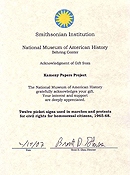
The Kameny Papers Project received this certificate from the Smithsonian Institution:
|
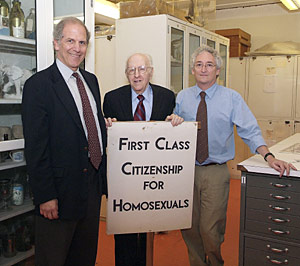
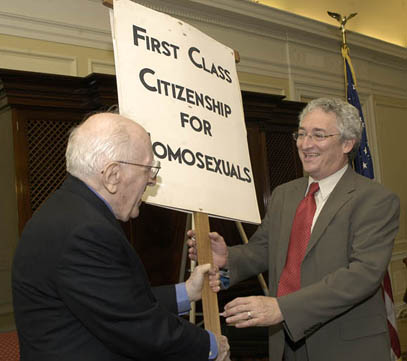
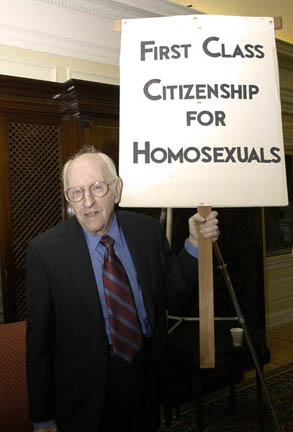
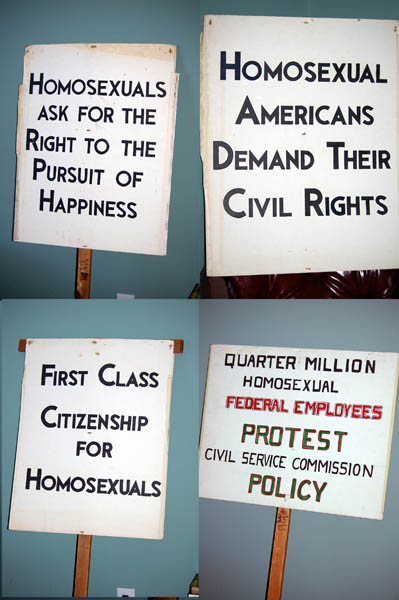
Kameny's Storybook Ending by Charles Francis The freight elevator opened with a shudder. It sounded like a death rattle. Gloved attendants pushed the sheet-covered gurney down a long corridor, stopping at the doors to a vault. The doors opened onto a room of drawers and lockers surrounding a platform —like a morgue. We gathered and held our breath as the attendants rolled back the shroud. Where one might expect a pair of legs were wooden sticks. Nicked and numbered, the sticks were not attached to a corpse but a neat pile of well-aged picket signs, hand-lettered, “First Class Citizenship for Homosexuals.” Frank Kameny stood silent, at near attention. And this man was rarely silent. The pickets, carried in 1965, were delivered at that moment in 2006 from his attic to the nation’s — the vault of the National Museum of American History of the Smithsonian Institution. The pickets were placed on the platform. The Smithsonian curator laid them alongside the writing table where Jefferson wrote the Declaration of Independence; the inkwell used by Lincoln when signing the Emancipation Proclamation; and the pin worn by Alice Paul who went to jail picketing the White House for women’s suffrage. “Frank, this is where the pickets fit into American history,” the Smithsonian curator said. Read the full article at WashingtonBlade.com Kameny Farewell Viewing Scheduled for November 3
The Advocate The late LGBT rights activist Franklin E. Kameny will be honored with a farewell viewing service next month in Washington, D.C., as well as a Smithsonian museum display that opens Friday. Read the full details at Advocate.com APNewsBreak: Gay rights papers shown at US library
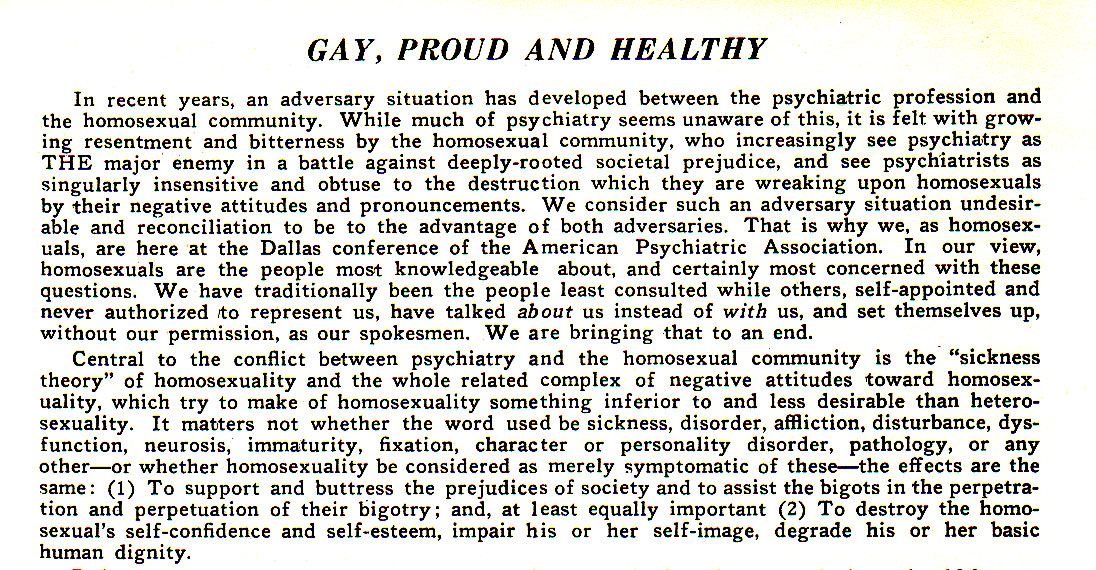
(AP) – May 8, 2011 WASHINGTON (AP) — Documents from gay rights history are on display for the first time at the Library of Congress as part of an exhibit on the nation's constitutional history and civil rights protections. The documents come from gay rights pioneer Frank Kameny, who was fired as a government astronomer in 1957 because he was gay. The library is showing Kameny's 1961 petition to the U.S. Supreme Court, contesting his firing. Though it was denied, Kameny's was the first petition to the high court for a violation of civil rights based on sexual orientation. He argued the government's actions toward gays were an "affront to human dignity." "This inclusion is an epic milestone in the telling of gay history because it places gay Americans' struggle for equality where it belongs — in the story of the Constitution itself," Charles Francis, a founder of the Kameny Papers Project, told The Associated Press. The library quietly placed the documents on view at the end of April in an exhibit called "Creating the United States," which traces the evolution of the nation's founding documents and legal framework. Organizers of the Kameny Papers Project, which donated about 50,000 items to the library in 2006, announced the display Monday. From the title of the exhibit, Kameny, now 85, said he can claim a new title for himself. "I suppose you can say at this point, I have become one of the creators of the United States, which I never would have imagined in 1961," Kameny said with a chuckle. "All I can say is from the long view, 50 years, we have moved ahead in a way that would have been absolutely unimaginable back then." The library also is displaying a 1966 letter from the head of the U.S. Civil Service Commission under President Lyndon B. Johnson, justifying the firing based on the "revulsion of other employees." It was introduced last year as evidence in the battle over gay rights in California to show a long pattern of treatment by the federal government. In 2009, Kameny received a formal apology for the "shameful action" of being fired solely based on his sexual orientation from the successor to the Civil Service Commission, the U.S. Office of Personnel Management. "So in a sense, it took 50 years, but I won my case," Kameny said. Yale Law Professor William Eskridge, an expert on the history of gay rights, said the Kameny papers show how the government's reasons for excluding gay rights shifted over time while Kameny's position was consistent. They are the work of the initial protester, strategist and leader of a major social movement, he said. "Frank Kameny was the Rosa Parks and the Martin Luther King and the Thurgood Marshall of the gay rights movement," Eskridge said. "That's why it's important that his papers are available because they're the innermost workings of this great strategist and leader — and they're, of course, archival records of the movement itself," he said. Library spokeswoman Jennifer Gavin said the Kameny papers were chosen for the exhibit because they deal with civil rights issues. "They are simply pertinent to the issue," she said. The papers are part of a rotation of hundreds of documents placed on view since the exhibit opened in 2008 and will likely be on view at least four months. Kameny, now 85, began fighting for gay rights more than a decade before the Stonewall riots in New York City. The Stonewall rebellion in 1969 proved to be a defining moment as gays and lesbians fought back against police raiding a gay bar. It's celebrated with an annual gay pride march. In 1965, Kameny was the first to stage a gay rights protest in with about 10 others in front of the White House and later the Pentagon and elsewhere with signs that read: "Homosexuals Ask For the Right to the Pursuit of Happiness," among other messages. He also took on the American Psychiatric Association to successfully argue that being gay or lesbian shouldn't be defined as a mental illness. How the Law Accepted Gaysby Dale Carpenter THE prestigious law firm King & Spalding has not fully explained its decision this week to stop assisting Congress in defending the law that forbids federal recognition of same-sex marriage. But its reversal suggests the extent to which gay men and lesbians have persuaded much of the legal profession to accept the basic proposition that sexual orientation is irrelevant to a person’s worth and that the law should reflect this judgment. The decision cannot be dismissed simply as a matter of political correctness or bullying by gays. Gay-rights supporters have transformed the law and the legal profession, opening the doors of law firms, law schools and courts to people who were once casually and cruelly shut out because of their sexual orientation. But it was a process that took a half-century to unfold. In 1961, a Harvard-trained astronomer, Frank Kameny, stood alone against the federal government. Fired from his federal job simply for being gay, he wanted to petition the Supreme Court. But at a time when all 50 states still criminalized sodomy, even the American Civil Liberties Union declared it had no interest in challenging laws “aimed at the suppression or elimination of homosexuals.” Mr. Kameny wrote his own appellate brief; without comment, the court turned him away. Over the next quarter-century, lifted by gales of change in sexual morality and in the status of women, gay-rights advocates mobilized at every level of the legal profession. In the late 1960s, they successfully challenged the antigay civil service policies under which Mr. Kameny had been discharged. In 1973, a small group of gay lawyers formed the Lambda Legal Defense and Education Fund, enlisting the help of prominent heterosexual lawyers. They drafted legislation protecting gays from discrimination in housing and employment. At the same time, gay-rights supporters began lobbying law schools, and then professional organizations like the American Bar Association, to adopt nondiscrimination policies. With these in place, they pressured schools to exclude law firms from on-campus recruiting unless they agreed not to discriminate against gay students in hiring. The Association of American Law Schools endorsed this approach. These developments paved the way for firms that had once fired suspected homosexuals to adopt their own nondiscrimination policies. Changes in the profession ran in parallel with the evolution of jurisprudence on sexuality. In 1986, in Bowers v. Hardwick, the Supreme Court upheld a Georgia sodomy law. Five justices — one of whom told a closeted law clerk that he had never met a gay person — dismissed the idea of a right to gay sex as “at best, facetious.” But four justices disagreed — a harbinger. Within a decade, openly gay law clerks had become unremarkable. In 1996, the year Congress passed the Defense of Marriage Act — the law it is now defending — the Supreme Court struck down an antigay state constitutional amendment in Colorado. Justice Antonin Scalia, dissenting, saw the tide turning. He tried to rewrite the narrative from one of a small and despised minority to one of an elitist legal corps disparaging ordinary Americans. The majority decision, he wrote, reflected “the views and values of the lawyer class from which the court’s members are drawn.” Any doubt left about where most lawyers stood was eliminated in 2003 in Lawrence v. Texas, which involved another sodomy law. Lambda Legal led the challenge, helped by Jenner & Block, a firm with extensive Supreme Court experience. Other big firms, groups like the American Bar Association and scholars filed supporting briefs. The cumulative effect of decades of work by gay-rights advocates was that the best firms and many of the best lawyers were unwilling to defend sodomy laws on constitutional, let alone policy, grounds. The court agreed, holding in Lawrence that such laws demeaned the very existence of gay people. No serious case can be made that an institution as powerful as Congress has a right to the services of the biggest law firms and the most credentialed lawyers. The Defense of Marriage Act is not unpopular, and while Congress may be indebted, it is not indigent. A thornier question arises when a firm withdraws from a representation, though in this case the quick withdrawal evidently caused no harm to the client. More troubling is the possibility that a firm might quit because of outside economic pressure rather than principle, though it is unclear whether such pressure played a role in this case. As Mr. Kameny’s lone crusade showed, the legal profession was not in the vanguard of gay rights. Unlike Mr. Kameny, of course, the House will have excellent counsel on its side: a former solicitor general who resigned from King & Spalding to protest its decision. The world of legal professionals is still a diverse one where basic values collide every day. Respectable constitutional arguments for the Defense of Marriage Act will surely be made — but grounded in ideas, one hopes, not contempt. Dale Carpenter, a law professor at the University of Minnesota, is the author of the forthcoming “Flagrant Conduct: The Story of Lawrence v. Texas.” Frank Kameny’s Brief for Gay Rightsby Jonathan Rauch In 1961, Frank Kameny, the pioneering gay-rights activist who was fired from his government job because of his homosexuality, asked the Supreme Court to intervene. The court ignored him and his appeal was forgotten—until now. Frank’s Supreme Court petition has resurfaced and is now in print via Amazon Kindle, courtesy of Charles Francis and the Kameny Papers project. It’s short; read it. At the very least, buy it (proceeds go to benefit Frank). It is a staggering document, not just of historical value but still, 50 years later, a summa of what the gay civil-rights movement is (or should be) about. Later in the 1960s, with the emergence of the countercultural left and the counter-countercultural response from the religious right, gay rights became a left-wing movement. (As one activist put it in the 1970s: “Never forget, what this movement is about is fucking.”) Frank, from the start, set his sights much, much higher, drawing a straight line from the Declaration of Independence and the Founders to gay individuals’ right to be left alone and choose their own destiny. The natural home for Kameny’s rhetoric and argumentation is the libertarian right, not the left. The voices he channels are those of Thomas Paine and Thomas Jefferson:
In a more rational country, gay equality would have been a conservative cause. When I say the document is staggering, I’m thinking of passages like this:
Imagine the vision and courage it took to say that…to the U.S. Supreme Court!…in 1961! He’s saying that being gay shouldn’t just be tolerated. It shouldn’t even be merely accepted. It should be admired! Half a century later, when 43 percent of Americans still tell Gallup that homosexuality is morally wrong, and when many gays are still reflexively hostile to the classical liberal tradition, the country is still struggling to catch up with Frank; but now, at least, we can all recognize this amazing man for the prophet he was. See for yourself.
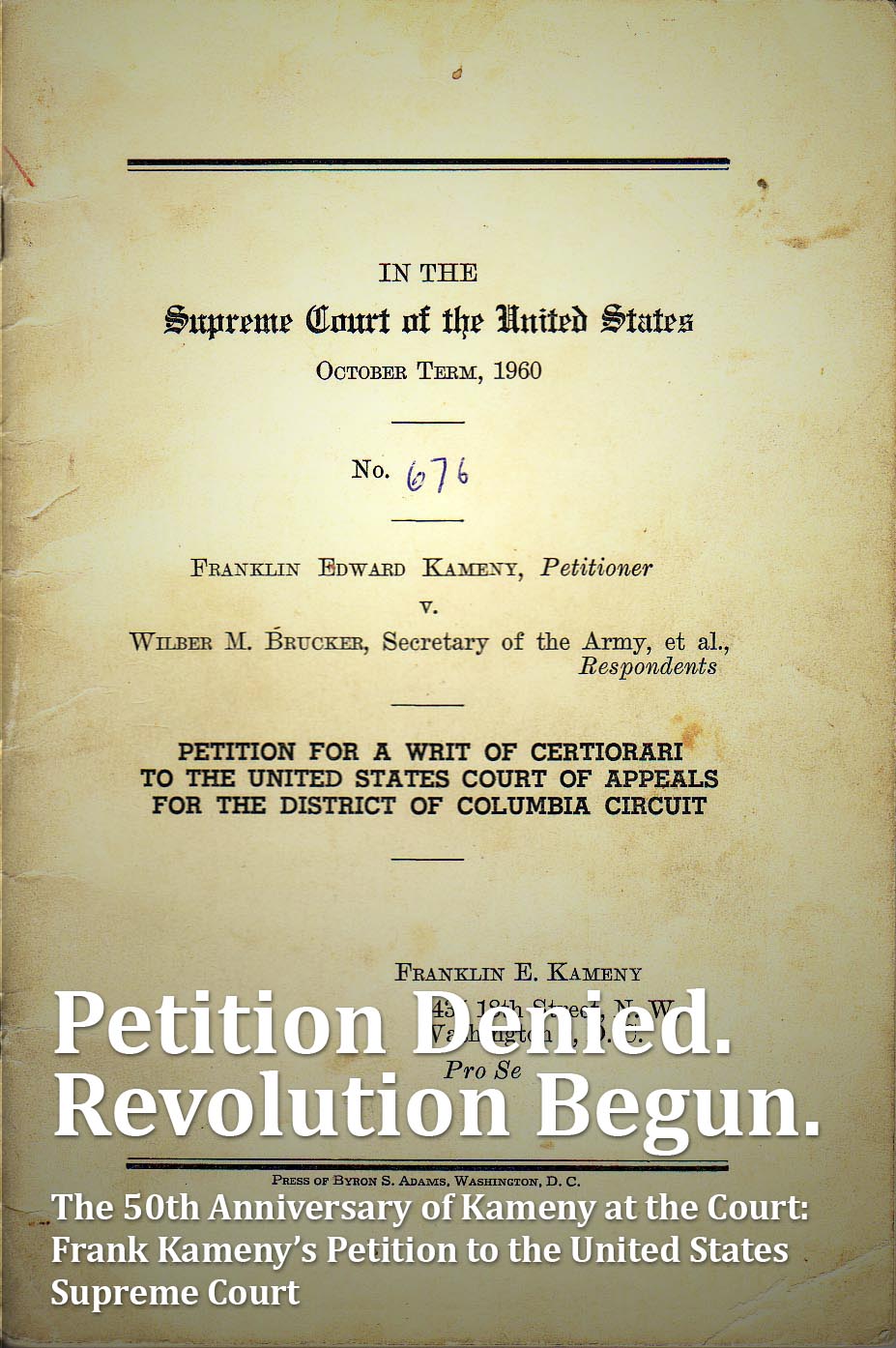
50th Anniversary of a Legal RevolutionCharles Francis Fifty years ago this week, in 1961 Frank Kameny picked up his copy of The Washington Star and read the bad news in a one inch column: "Petition Denied". Kameny's petition for a hearing of his case before the U.S. Supreme Court had been denied. Kameny was fired from his job at the United States Army Map Service in 1957 when he was discovered to be homosexual. Unlike so many gay men and women who had been discovered and fired because of the U.S. government's ban on homosexual employment, Kameny fought. Eight years before Stonewall, Kameny's petition laid out the argument for gay civil equality, not in the streets, but in the Declaration of Independence and the Constitution. He wrote the Court: Not only are the government's present policies on homosexuality irrational in themselves, but they are unreasonable in that they are grossly inconsistent with the fundamental precepts upon which this government is based...we may commence with the Declaration of Independence, and its affirmation , as an "inalienable right" that of the "pursuit of happiness". Surely a most fundamental , unobjectionable, and unexceptionable element in human happiness is the right to bestow affection upon and to receive affection from whom one wishes. Yet, upon pain of severe penalty, the government itself would abridge this right for the homosexual. Frank Kameny's Petition to the U.S. Supreme Court now available on Kindle eBooks March 22, 2011
"Petition Denied. Revolution Begun. The 50th Anniversary of Frank Kameny's Petition to the United States Supreme Court" ( $ 9.95, Kindle eBook, available at Kindle Books, Amazon.com) All proceeds to benefit Frank Kameny.
The first gay rights legal brief filed anywhere by anybody was submitted to the U.S. Supreme Court in 1961 by Frank Kameny, eight years before Stonewall. We have just published a special 50th Anniversary edition of "Petition Denied. Revolution Begun." as an eBook at Kindle, Amazon.com ( $9.95 ). as Band of Thebes reports: Already housed in the Library of Congress's collection of Kameny papers, his Supreme Court petition will become part of the library's ongoing exhibit "Creating the United States," when they update it in late April. This early demand for legal recognition of lesbian and gay equality will stand among documents by Jefferson, the Marquis de Lafayette, and other powerful voices in the shaping of America. from the Petition: "In World War II, petitioner did not hesitate to fight the Germans, with bullets, in order to help preserve his rights and freedoms and liberties, and those of others. In 1960, it is ironically necessary that he fight the Americans, with words, in order to preserve, against a tyrannical government, some of those same rights, freedoms and liberties, for himself and others. He asks this court, by its granting of a writ of certiorari, to allow him to engage in that battle." All proceeds to benefit Frank Kameny. If you have a Kindle reader order yours today, or tell a friend or library. Click here to purchase at Kindle Books Kameny Papers Expose a Dark Legacy January 18, 2011 from "The Gay and Lesbian Review"
by Charles Francis
 The "REVULSION LETTER" is on its way to the Supreme Court. Triggered by gay and lesbian Americans picketing the White House in 1965, and hidden away in the attic of pioneer gay civil rights activist Frank Kameny until he donated it to the Library of Congress in 2006, this letter established a viciously discriminatory federal policy toward homosexuals that lasted decades. It reverberates still, each time a judge scrutinizes a law that treats gay and lesbian Americans differently from everyone else." Read More
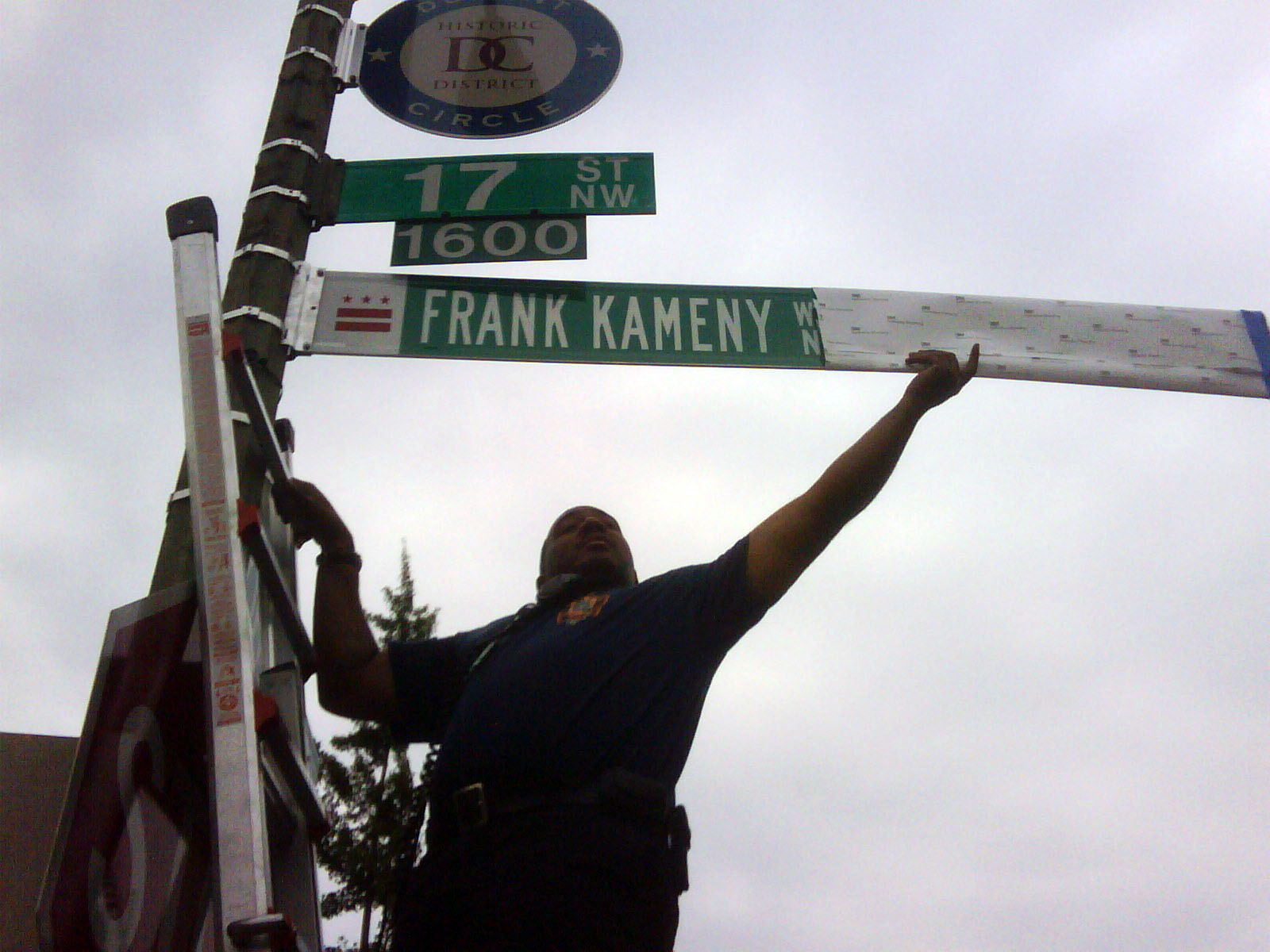
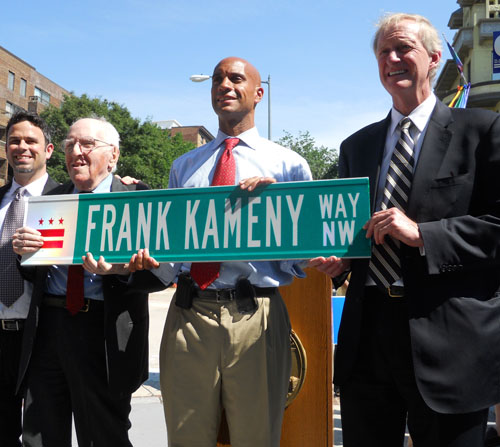
Frank Kameny Way- Washington, DC June 10, 2010
Congratulations, Frank!
Click to read the full text of Frank's letter to LBJ (full size)
(l to r) Frank Kameny, D.C. Mayor Adrian Fenty, D.C. City Councilman
1960s Letter to Mattachine Society of Washington, D.C. from Civil Service Commission Entered into Evidence, Perry v Schwarznegger Contact: Charles Francis Archive Activism: The story behind The Kameny Papers Project Remarks Thank you for the invitation to address your unique LGBT caucus within the Special Libraries Association. It is exciting to speak before a group of librarians and researchers who work for Fortune 100 companies, think tanks, universities and research services. You totally understand the value of archives and in-depth research, and have a unique perspective on how this intersects with LGBT issues. Looking back on the Frank Kameny Papers Project--- our effort to save and secure one of the great collections of LGBT history---I now realize saving and conserving a gay archive or primary material is a kind of activism. We think of history as text. We think of history as something that exists. Kameny Papers Project Artifacts Slideshow
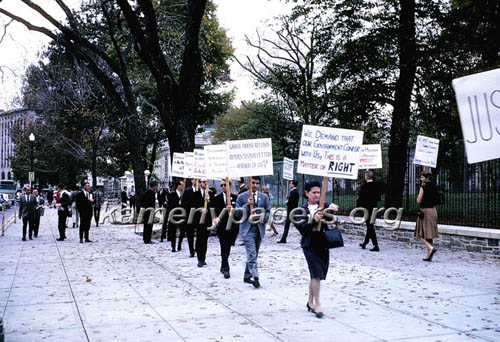
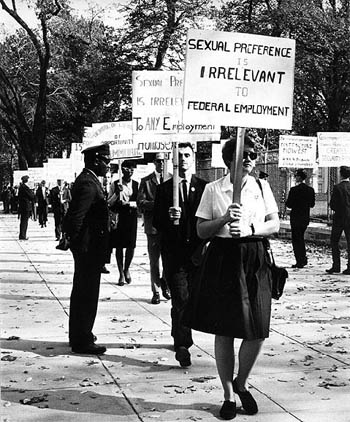
June 8, 2009-- Check out this inspiring Associated Press slide show, pegged to the upcoming 40th Anniversary of Stonewall and Frank's antecedent activism in Washington, D.C. The featured pickets are those that did not go to the Smithsonian's National Museum of American History. The photograph of the picketers is now at the Library of Congress. Read the L.A. Times article on Frank Kameny.
Frank Kameny comments, December 2008, almost 40 years later, on his Opening "Throw Down the Gauntlet" Statement at Benning Wentworth's hearing: It eventually went to court, where it was joined with Gayer (who lived in San Francisco), and Ulrich (from DC; now deceased). Wentworth was from New Jersey. I was Personal Counsel for all three at the administrative level. As Gayer, Wentworth, and Ulrich v. [Sec. of Defense] we won a soft victory in the Court of Appeals (9th Circuit, I think, but perhaps the DC Circuit) about 1973.
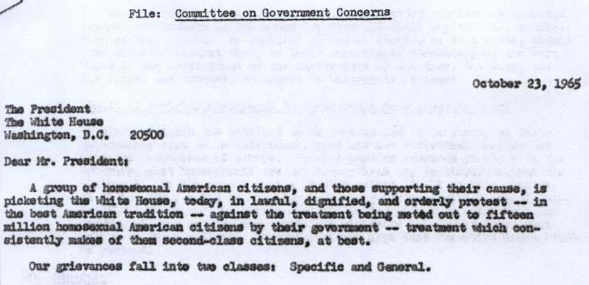
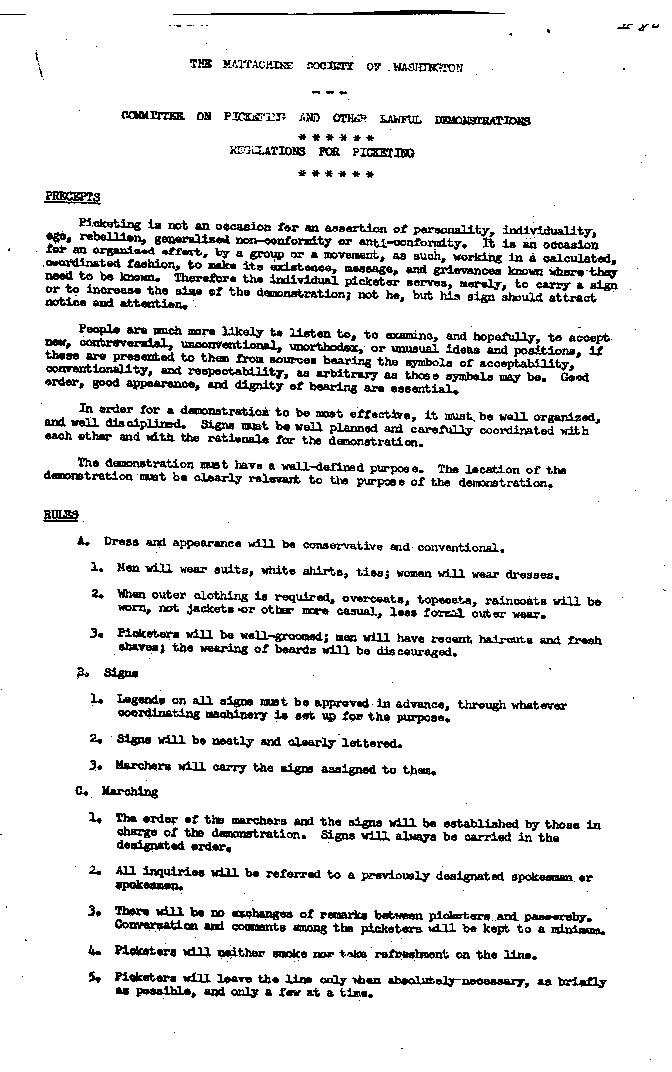
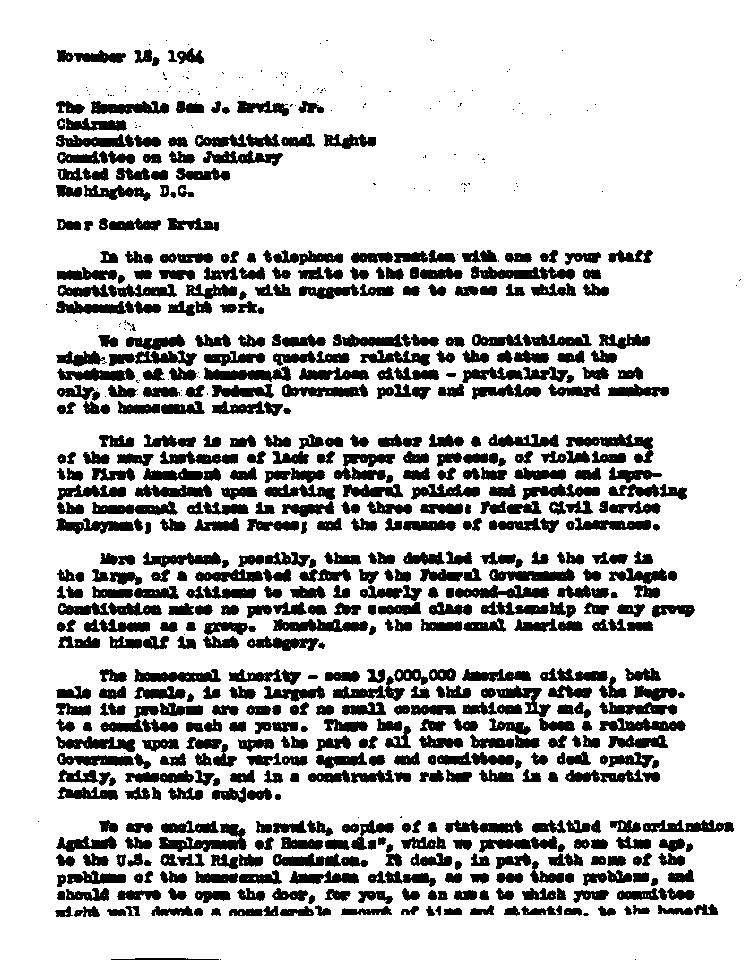
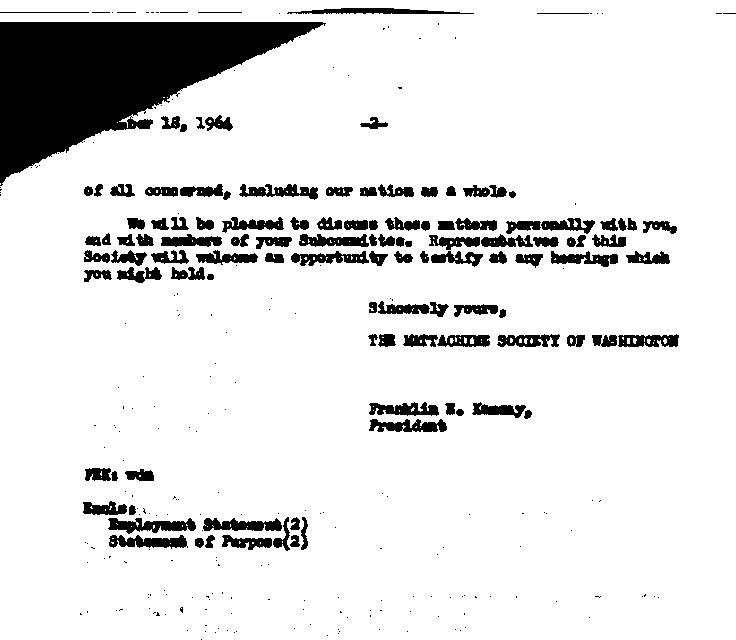
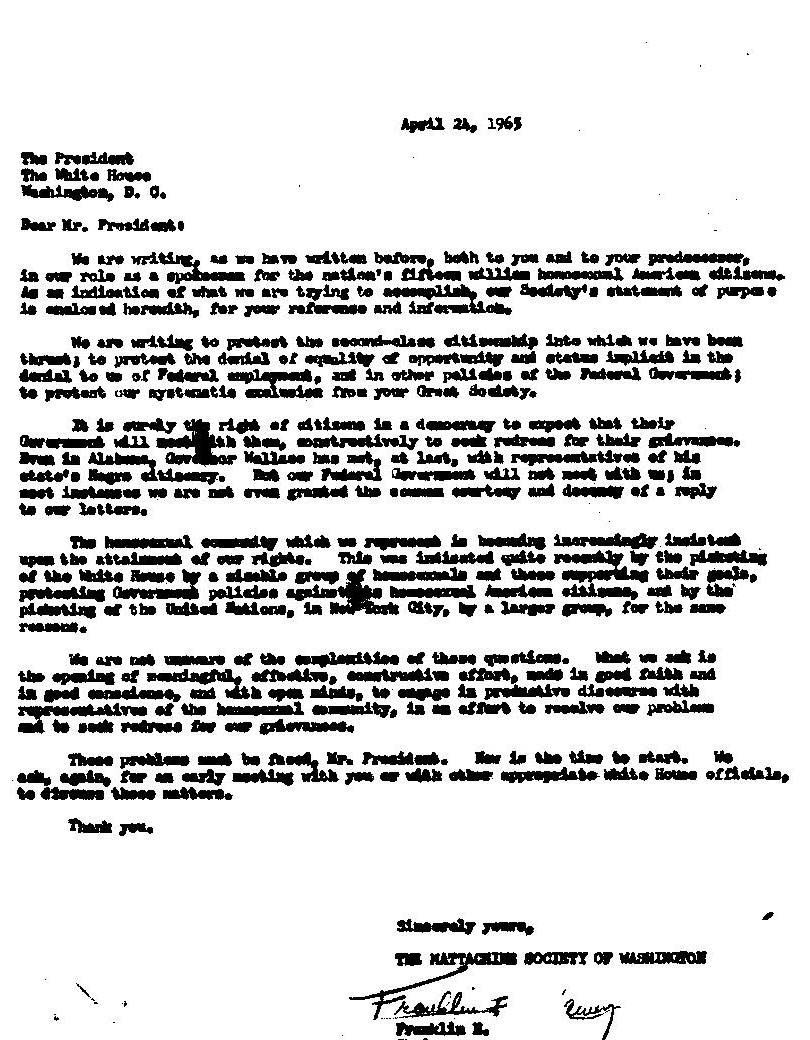
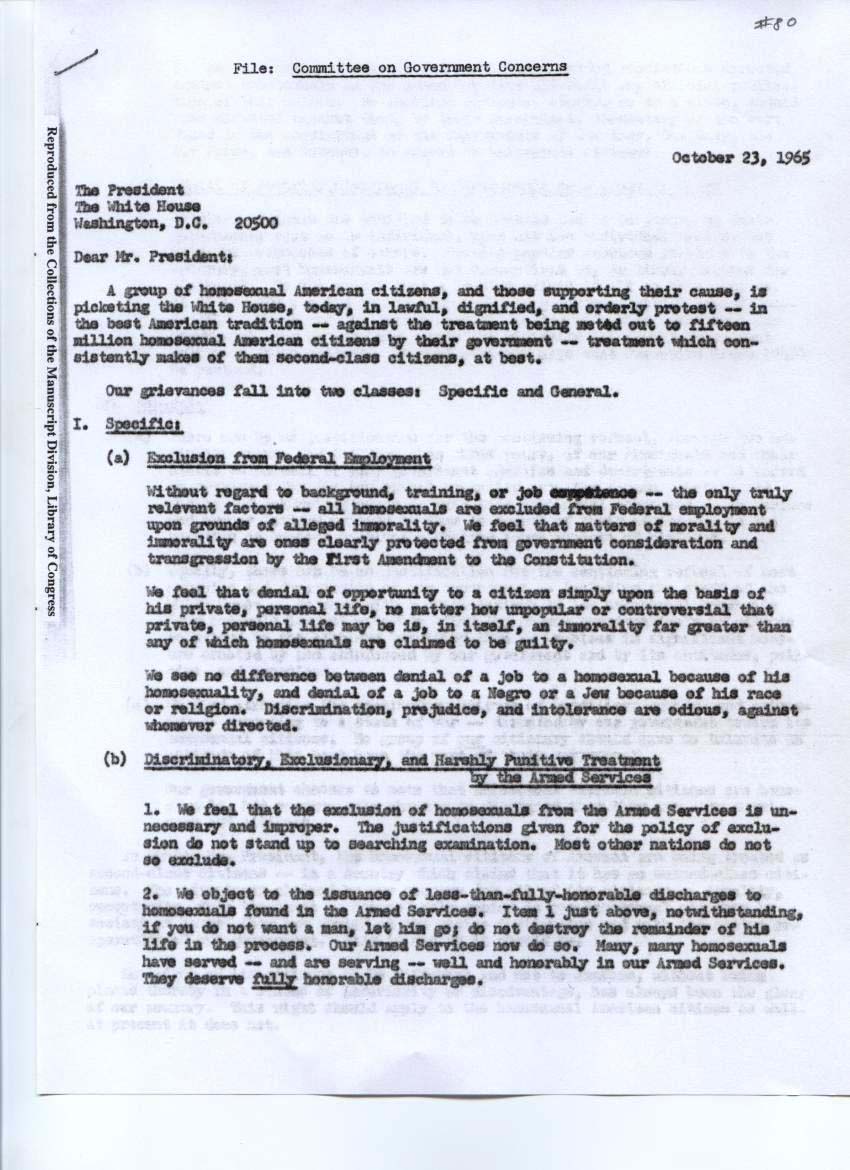
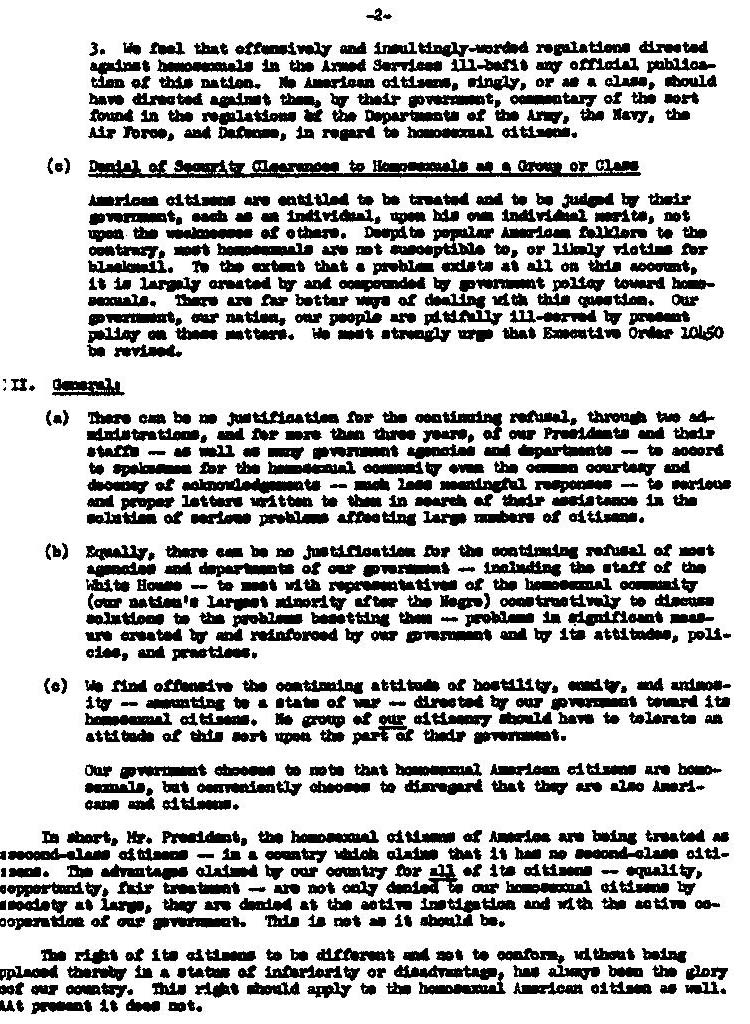
NEW from the Kameny Archive at the Library of Congress Mattachine Society letters from the 1960s make the intellectual case, the government relations case and the “retail” individual case for gay men and women nationwide. The Mattachine Committee on Picketing and Other Lawful Demonstrations, Regulations for Picketing (Box # 80). “Precepts: Picketing is not an occasion for an assertion of personality, individuality, ego, rebellion, generalized non-conformity or anti-conformity. It is an occasion for organized effort. … Men will wear suits, white shirts, ties; women will wear dresses.” Letter (1963) to Mattachine from Lawrence Jones, Deputy General Counsel, Department of Commerce, “You are instructed and directed to remove my name from your mailing list”. Responds Kameny: “ You have no authority to so instruct and to direct. You are a public official. In this country, ALL citizens whether acting singly or collectively, have the right, at ANY time, to write to ANY public official, about ANY matter.” (Box # 82). Memo to Homophile Organizations (1963) from The Mattachine Society of Washington, D.C., regarding Congressional hearings to strip Mattachine of its tax-exempt IRS status. (Box # 82): “To our knowledge, this was the first time that the homosexual community has stood up to Congress.” (Representative John Dowdy, D-Texas, goes after the Mattachine. Letter to The Daughters of Bilitis (1964) from the Neuropsychiatric Institute, UCLA. “We are studying the medical, ethical and legal implications of so-called ‘change of sex’ operations.” Letter from The President’s Committee on Equal Employment Opportunity (1962) to the Mattachine: “Unfortunately, the problem you raise is beyond the purview and resources of this Committee, Very truly yours.” Kameny letter to The Honorable Sam Ervin, chairman, Subcommitee on Constitutional rights, U.S. Senate (1964): “ We suggest the Subcommittee explore questions relating to the status and the treatment of the homosexual American citizen…” Page 1 Page 2 Letter to the D.C. Mattachine (1964, handwritten): About two years ago while employed with the U.S. Department of Agriculture, I was called into the office of one of the Security Officers. This “gentleman” notified (me) that someone had named me as a partner in his homosexual activities. “ Letter to the D.C. Mattachine (Box 81), 1964. “Mr. Kameny, on May 13, 1960, I was given an Undesirable Discharge from the U.S. Air Force on the assumption that I am homosexual. At the time of my discharge, I had completed 16 years and 1 month with a perfect service record. Also, I served through out World War Two in the South Pacific. I had won three Battle Stars and many medals not to mention earning the Good Conduct Medal every three years.” Letter to Frank Kameny from Wallace Dickson, Virginia House of Delegates, Arlington, Va., 1968 (Box 81): “In the practice of criminal law I observe many injustices and am in accord with your view that modernization of the law is in order. Any assistance you and your organization can lend me would be greatly appreciated.” Letter to Rona Barrett, Hollywood Reporter, Washington, D.C. from Frank Kameny (1969, Box 81): “ Your comments are remarkably similar to those heard in the South in past (and present) years. ‘We all know that Negroes and whites marry, but must we seem them on the screen?” Letter from Secretary to Justice Hugo L. Black (1962), “Dear Dr. Kameny, Justice Black has asked me to advise you that it will not be possible for him to accept your invitation to speak”, responding to a two page Letter of Invitation from Kameny. “Dear Frank, My court case turned out fine, charges changed to disorderly conduct and a fine, so I’m through, Thank God. The Norfolk Vice-Squad and Police dept. have decided to rid Norfolk of the Homosexual element here.” (Box 81), Letter to Kameny at Mattachine, 1969. “Dear Sirs, I am a homosexual. I came across your name in this past issue of Time. I called long distance and obtained your phone number. … I need help.” Letter to Mattachine, 1969 (Box 81) Letter to The President, The White House, Washington, D.C., from Frank Kameny, 1965. (Box 80). “Dear Mr. President, We are writing to protest the second-class citizenship into which we have been thrust; to protest the denial of equality of opportunity and status implicit in the denial to us of Federal employment, and in other policies of the Federal Government; to protest our systematic exclusion from your Great Society.” “Dear Mr. President, A group of homosexual American citizens, and those supporting their cause, is picketing the White House, today, in lawful, dignified, and orderly protest---in the best American tradition---against the treatment being meted out to fifteen million homosexual American citizens by their government---treatment which consistently makes of them second-class citizens, at best.” (Letter from Frank Kameny, for Mattachine Societies in Washington,D.C., Chicago, New York, Philadelphia and Florida, to President Lyndon Johnson, Box 80, 1965) Page 1 Page 2 Letter from Vice President Hubert Humphrey (1965, Box # 80) to Frank Kameny. “Dear Mr. Kameny, Neither the Federal Executive Orders on fair employment nor the Civil Rights Act which constitute the authority for this program of non-discrimination are relevant to the problems of homosexuals. Best Wishes.” Kameny Papers Archive Now Available at Library of Congress September 11, 2008
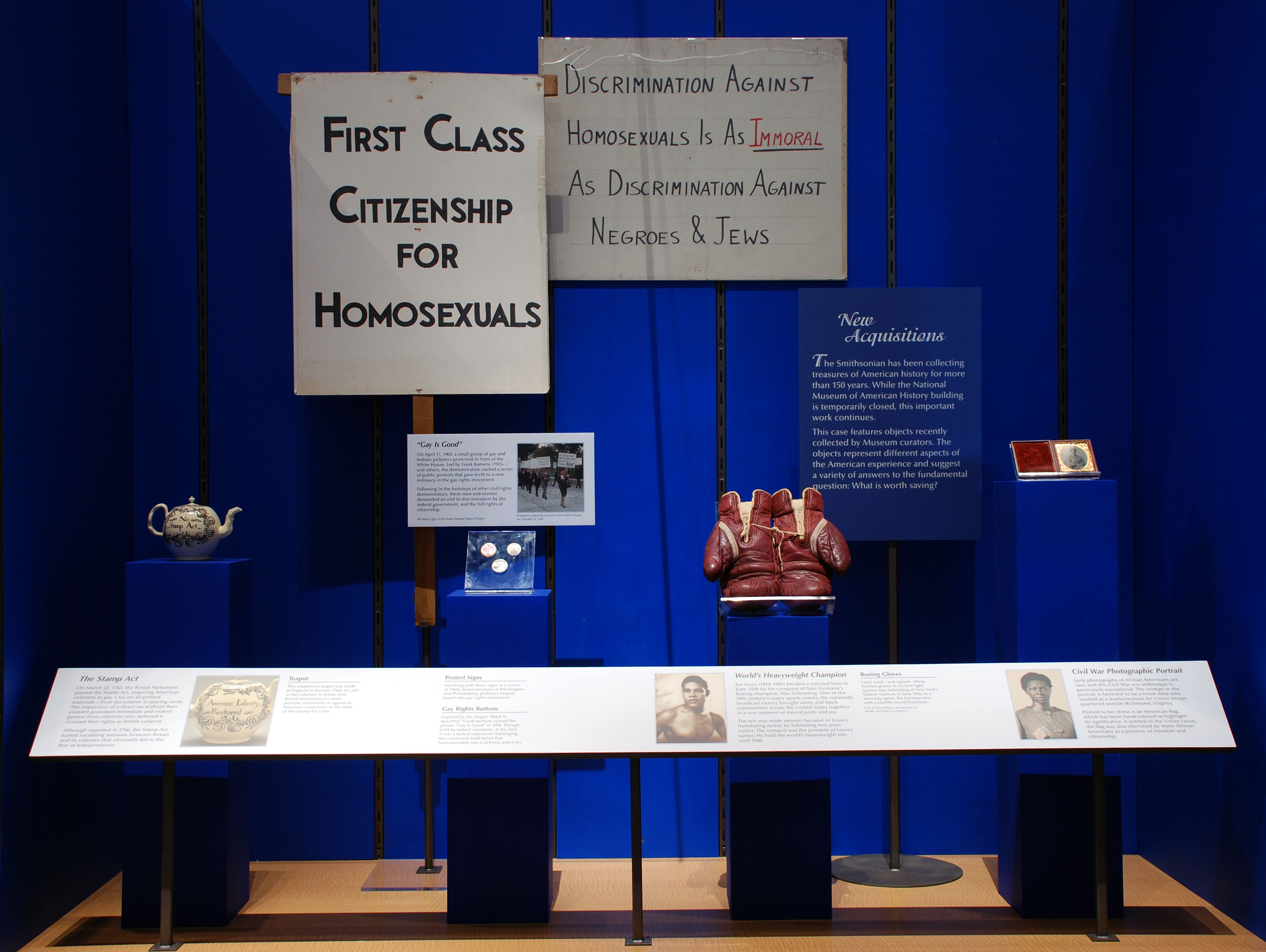
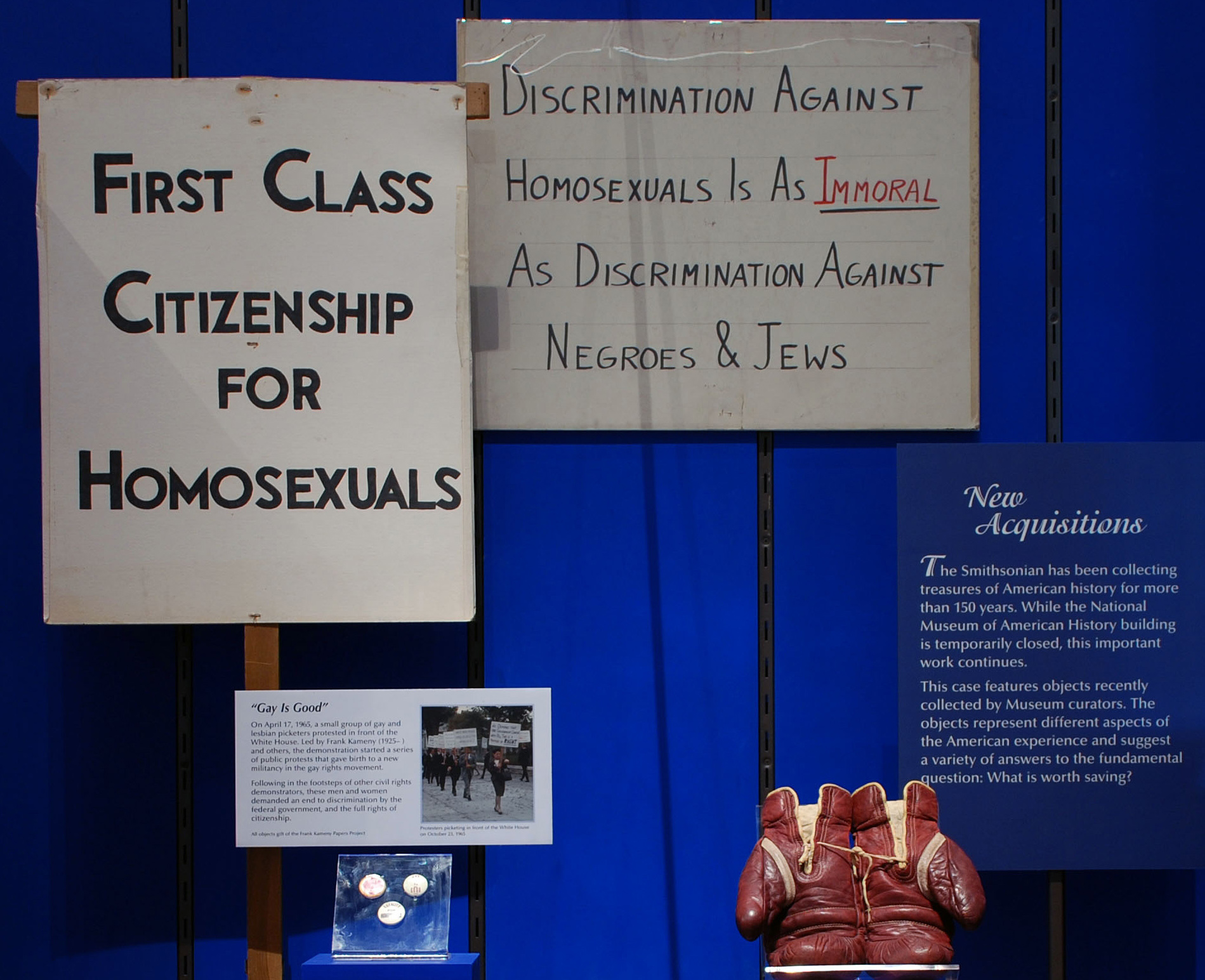
Washington Post on Kameny Smithsonian Exhibit September 8, 2007 The obvious question gets the obvious answer: Of course Frank Kameny, a pioneer of the gay rights movement, had no inkling that the protest signs he carried more than 40 years ago would end up in the Smithsonian . But there they are, hand-lettered, with little stains from their staples discoloring the faded white cardboard. Two of them, plus three campaign buttons, are now in the same case as Joe Louis's boxing gloves, near the glass closet that holds Jackie Kennedy 's inaugural gown and in the same shrinelike exhibit known as "Treasures of American History" that also has Thomas Jefferson 's writing desk and the ruby-red slippers that Dorothy wore on her way to meet the Wizard. Kameny, now 82, was on hand Thursday evening to see the very functional tools of his early activism officially made totems of American history. Although the objects are part of the Smithsonian's National Museum of American History's collection, the reception was held at the National Air and Space Museum , which is offering space for the must-see icons while the history museum itself is closed for renovation. Go here to read the whole article Kameny Papers Smithsonian Video on YouTube
Kameny Pickets and Buttons on Display at the Smithsonian While the National Museum of American History is closed for renovations until Summer 2008, some of Frank Kameny's donated picket signs and buttons are already on display as part of an exhibit entitled "Treasures of American History" at the National Air and Space Museum. For the benefit of readers unable to visit Washington, D.C., we have reproduced the text of the display here. "Gay Is Good"(the name of the display )
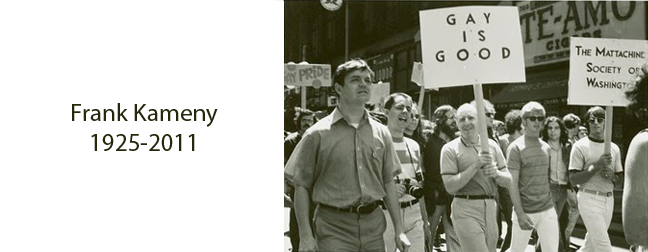
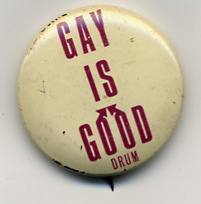
(Accompanying a photograph of picketers):"On April 17, 1965, a small group of gay and lesbian picketers started a series of protests that gave birth to a new militancy in the gay rights movement. Following in the footsteps of other civil rights demonstrators, these men and women demanded an end to discrimination by the federal government, and the full rights of citizenship." (Accompanying 3 buttons, two of which read "Gay is Good"): "Inspired by the slogan "Black is Beautiful" Frank Kameny (1925- ) coined the phrase "Gay is Good" in 1968 . Though mild by today's standards, at the time it was a radical statement challenging the commonly held belief that homosexuality was a "sickness and a sin". Other objects in this case which is to display New Acquisitions of the National Museum of American History are a pair of boxing gloves worn and signed by Joe Louis from his fight with Max Schmelling; a teapot that says "No Stamp Act"; and a rare photograph of a freed slave wearing an American flag.
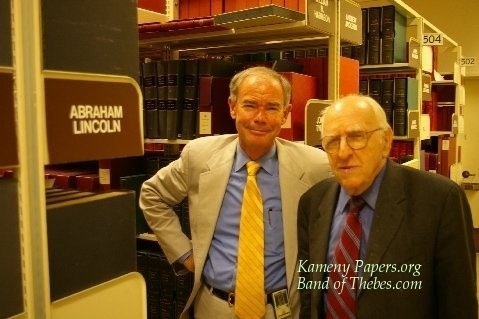
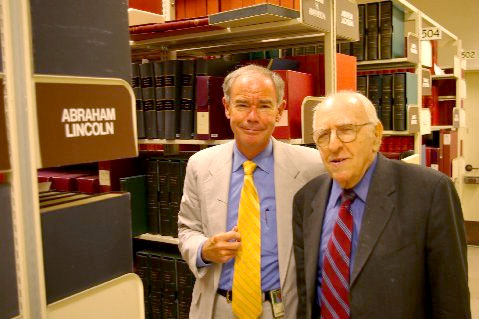
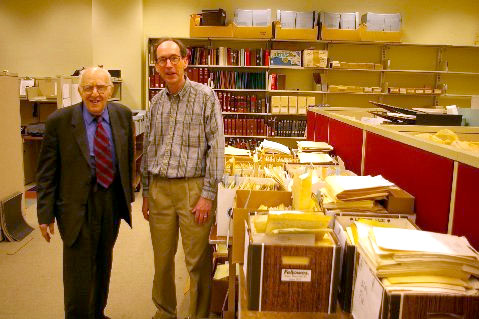
Friends, Frank and I visited the Manuscript Division of the Library of Congress yesterday. We were invited to witness the process of unpacking Frank's boxes, now well underway; and the sorting of thousands of pages of materials into an index or "Register". Frank's boxes were aligned on long sorting tables. Charles
In the stacks with John Haynes, political historian.
with archivist Michael McElderry; scheduled completion of Kameny Register, end of '07
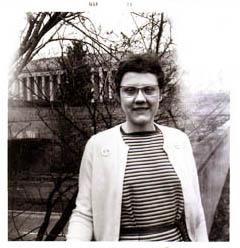
Frank Kameny remembers "Founding Mother" Barbara Gittings: Entering the
gay scene in the mid-'50s with a firmly-stated rejection for herself
personally of the then almost universal dichotomy among Lesbians into"femmes" and "butches" she moved ahead to take a leadership role first
in the Lesbian scene through the Daughters of Bilitis and then, in the
'60s and onward, into the broader Movement through interactions with the -Frank Kameny 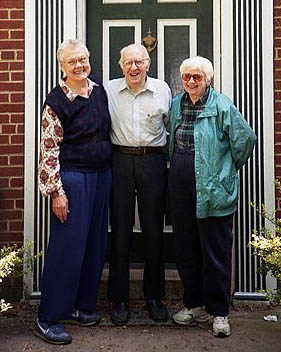 (L to R) Barbara Gittings, Frank Kameny, and Barbara's life partner, Kay Lahusen, at Frank's front door in Washington , D.C. (2004) (Photo: Frank Kameny)
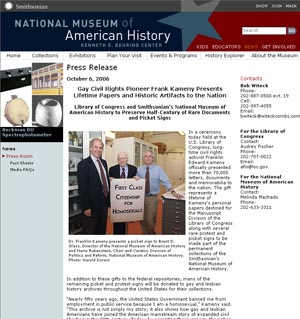
Press Release Contact: Bob Witeck For the Library of Congress For the National Museum of American History Gay Civil Rights Pioneer Frank Kameny Presents Washington , D.C. October 6, 2006 – In a ceremony today held at the U.S. Library of Congress, long-time civil rights activist Franklin Edward Kameny officially presented more than 70,000 letters, documents and memorabilia to the nation. The gift represents a lifetime of Kameny's personal papers destined for the Manuscript Division of the Library of Congress along with several rare protest and picket signs to be made part of the permanent collections of the Smithsonian's National Museum of American History. In addition to these gifts to the federal repositories, many of the remaining picket and protest signs will be donated to gay and lesbian history archives throughout the United States for their collections. “Nearly fifty years ago, the United States Government banned me from employment in public service because I am a homosexual,” Kameny said. “This archive is not simply my story; it also shows how gay and lesbian Americans have joined the American mainstream story of expanded civil liberties in the 20th century. Today, by accepting these papers, the nation preserves not only our history but marks how far gay and lesbian Americans have traveled on the road to civil equality.” To make this once-in-a-lifetime gift possible, a volunteer donor group offered to support Kameny and his wishes. With advancing years and limited means, Frank Kameny was not eligible for a federal tax deduction, as is common with such an extraordinary donation. Following an expert appraisal of the documents, several individuals and groups stepped forward to partner with Frank Kameny and to establish the brief-lived Kameny Papers Project (details at www.kamenypapers.org ). It also has long been Kameny's wish to ensure the papers – once stored in his Washington , D.C. attic – remain in the Nation's Capital, his home for over five decades and that they ultimately are made available to all for historical research. The gift was made possible through an original matching grant from a former M ember of Congress, the Honorable Michael Huffington, as well as additional generous contributions from organizations and individuals including The Human Rights Campaign Foundation, Gill Foundation, Bohnett Foundation, Log Cabin Republicans and the Liberty Education Forum as well as Donald Capoccia, Charles Francis, M el Heifetz , Gregory King, Elizabeth Koontz, Jonathan Rauch, Ellen Ratner and Stephen Salny, as well as pro bono contributions from Joiner Law Firm, Attorney Michele Zavos, and Witeck -Combs Communications, Inc. Richard Rosendall serves as ‘attorney-in-fact' for the Kameny Papers Project. The Kameny archive includes thousands of pages of letters, government correspondence, testimony, photographs, picket signs and other memorabilia ( www.kamenypapers.org ). The Kameny papers trace the arc of the gay civil equality movement in the U.S. through Kameny's life and activism from the 1950s to the present. The collection includes original photographs of gay men and women picketing the White House in 1965 along with the original picket signs; the original policy statement of the U.S. Civil Service Commission (1966) explaining to Kameny the legal arguments why homosexuals “are not suitable for federal employment”; documents tracing the formation and advocacy of The Mattachine Society of Washington; documents from the American Psychiatric Association and the fight to “de-list” homosexuality as a mental illness; and impassioned testimony by Dr. Kameny in defense of scores of homosexuals being stripped of security clearances, and fired from their government jobs. The Kameny papers now become part of the nation's repository of personal papers in the M anuscript Division of the Library of Congress where they will become available to historians and researchers after they are processed by the Library. The Manuscript Division of the Library of Congress includes the original letters and papers of great Americans from all walks of life---from Frederick Douglass, Walt Whitman and Abraham Lincoln to Susan B. Anthony and Bayard Rustin and a thousand other historic figures. Many of Kameny's original picket signs carried in front of the White House, the Pentagon and the U.S. Civil Service Commission will be made part of the political history collections of the National Museum of American History. There they will join similar artifacts such as abolition broadsheets, suffragist banners and civil rights protest signs collected from groups around the country. ###
Introduction Who is Dr. Franklin E. Kameny and why does his archive-- his correspondence, papers, and memorabilia collected over fifty years-- matter so much to historians, researchers, and all Americans interested in the expansion of liberty in the United States? Read this 1960 Letter from the U.S. State Department (John W. Hanes, Administrator) to Dr. Kameny confirming that the Department "does not hire homosexuals and does not permit their employment" to get a clue. Or read this Statement to Dr. Kameny's Mattachine Society from the U.S. Civil Service Commission (John Macy, Chairman U.S. Civil Service Commission, 1966) to grasp the arc of his activism. Today, it is hard to believe the level of official hostility faced down by Frank Kameny, perhaps the most influential gay activist of his time. The KamenyPapers archive is a marker in time of the animus, as well as the progress, made in the last half-century. You won't find this anywhere else, on-line or inside the government or in a library, because it has been residing in Frank Kameny's attic for 46 years now…..along with 25 boxes of documents, correspondence and memorabilia from the earliest days of the gay civil equality movement in America . Kameny, like Rosa Parks before him, and the Suffragists before her, dared to step forward into the public square to say “enough” to government-sanctioned discrimination, and to educate and expand freedom in America . This site is a sampler of the thousands of pages of documents that are in the archive of Frank Kameny, the leading gay civil rights advocate of his time. A self-described “pack rat”, Kameny saved every scrap of paper, every picket sign, every letter, making this archive perhaps the most complete and exciting archive in the gay civil rights movement. This fact has been recognized by both The Library of Congress and the Smithsonian Museum of American History. KamenyPapers.com is a sampler of Frank Kameny's archive, which we aim to protect and place in a national library or archive for the benefit of researchers and historians for generations to come. Please join us in this important effort.
|